
Salt air and HVAC in Calabash and Sunset Beach, NC
Salt air is hard on HVAC equipment, and the damage starts long before anything looks wrong. In Calabash and Sunset Beach, homes sit close enough to open water that salt settles on the metal that has to shed heat all summer. Here is what corrodes, the cadence that fights it, and when to call.
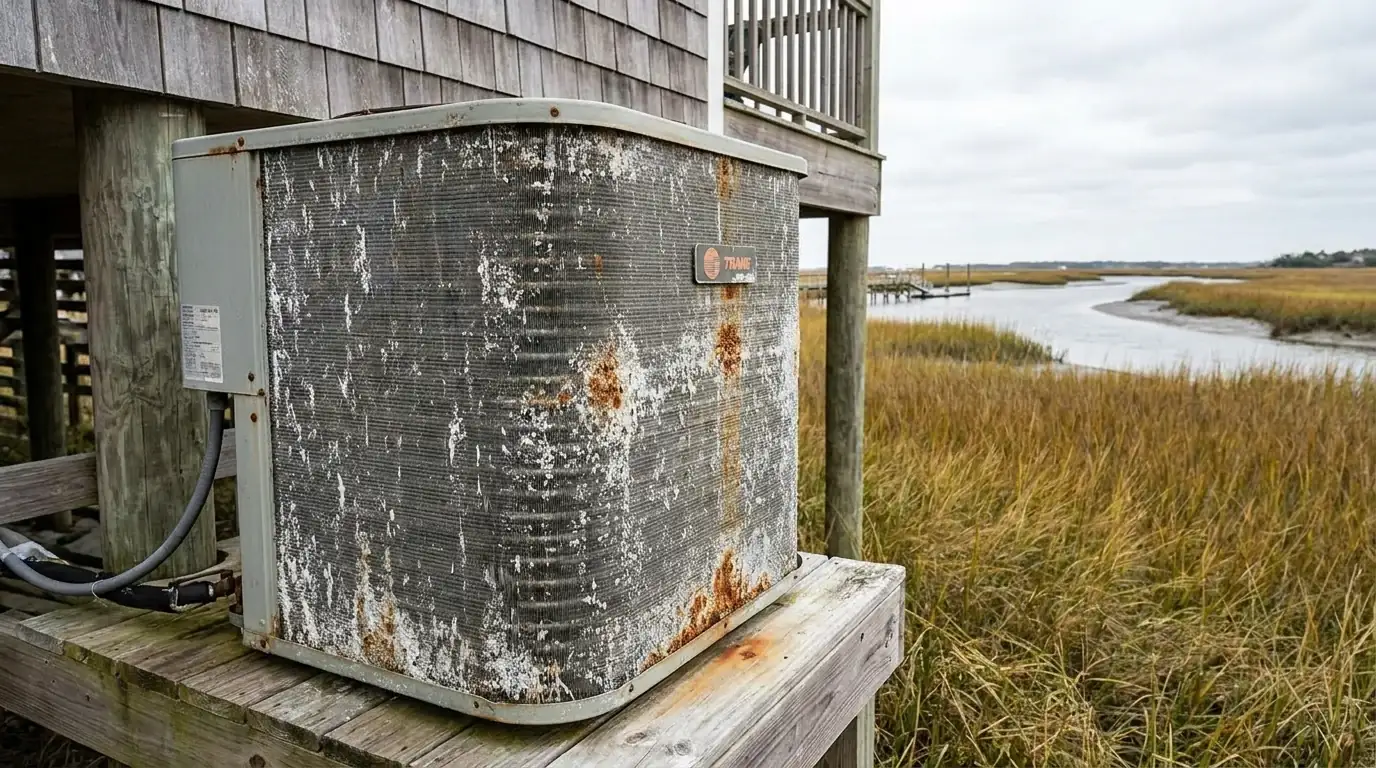
Salt air is hard on HVAC equipment, and it reaches your outdoor unit long before anything looks wrong. In Calabash and Sunset Beach, most homes sit within a mile or two of the Intracoastal Waterway or open Atlantic water, and the salt that rides in on the breeze settles on the same metal that has to shed heat all summer. That changes what HVAC maintenance and repairs need to look like here compared with a house twenty miles inland. This guide covers what corrodes, what you can do yourself, and when the problem stops being a homeowner job.
Quick answer
What does coastal air do to an HVAC system?
Salt air corrodes outdoor HVAC coils and cabinets faster in Calabash and Sunset Beach than inland, because Brunswick County homes sit within a mile or two of open water. Comfort Masters Heating & Cooling services both towns and recommends a monthly condenser rinse, a filter check every 30 days in season, and indoor humidity held between 30 and 50 percent.
On this page
- 01Why these two towns are harder on equipment
- 02What salt air actually does
- 03What coastal maintenance looks like
- 04Three things you get told that are not true
- 05When to stop rinsing and call someone
- 06Common questions
- 07Sources and references
Why Calabash and Sunset Beach are harder on equipment
Brunswick County sits at the top of the same coastal strip as the Grand Strand, and the equipment here works under two loads at once. One is salt. The other is moisture that never fully leaves the air. Both run on a longer calendar than the cooling season most manufacturers design around. Our coastal Carolina HVAC guide covers the regional picture; this section is about what makes these two towns specific.
Salt, wind, and the distance to open water
Sunset Beach is an island town. Calabash sits on the Calabash River a short distance from the waterway. In both, onshore wind carries fine salt particles inland and deposits them on whatever they land on, including the aluminum fins and copper coils inside your outdoor unit.
Salt on dissimilar metals in a damp environment drives galvanic corrosion, which is the electrochemical process that eats the metal from the surface inward. It does not announce itself. By the time a fin crumbles under a fingernail, the process has been running for seasons.
Humidity load runs longer here than the calendar suggests
An air conditioner does two jobs. It lowers temperature and it removes moisture. On the coast the second job is the harder one, and a system that satisfies the thermostat quickly can leave a house cool and still clammy.
The Environmental Protection Agency recommends keeping indoor relative humidity below 60 percent, and ideally between 30 and 50 percent, to control mold and moisture. Hitting that range in a Brunswick County summer takes a system sized to run in longer cycles, not a bigger one.
6mo
Hurricane season runs June 1 through November 30 every year.
NOAA puts the peak at September 10, with most activity between mid-August and mid-October. That six-month window overlaps the hardest part of the cooling season, so a Brunswick County system carries storm exposure and peak runtime at the same time.
Atlantic hurricane season dates and peak per the NOAA National Hurricane Center.
What salt air actually does to a coastal system
Salt damage shows up in three places, and they fail differently. Coil and fin corrosion costs you heat transfer. Cabinet, fastener, and electrical corrosion costs you reliability. Blocked condensate drains cost you humidity control. We repair any brand, so the pattern below holds whatever badge is on your cabinet.
Coil and fin corrosion
The outdoor coil sheds heat through thin aluminum fins packed close together. Salt settles between them, holds moisture against the metal, and corrodes it. Refrigerant work during the resulting repair is handled under EPA 608 certification.
Fin degradation and airflow loss
Corroded fins thin, bend, and eventually break away. Air moves through the gap instead of across the metal, and the system runs longer for the same result.
Refrigerant leaks at the coil
Corrosion that reaches the tubing behind the fins opens pinhole leaks. Low refrigerant means weak cooling, and topping it off without finding the leak just pays for the same problem twice.
Cabinet, fastener, and electrical corrosion
The cabinet, screws, and mounting hardware corrode on the same schedule as the coil. Inside the electrical compartment, contactor points pit, and a pitted contactor either fails to close or welds shut. Both show up as a unit that will not start on a hot afternoon.
Condensate drains and standing water
A coastal system pulls a lot of water out of the air on a July day. When the drain line clogs, that water backs up into the air handler or onto the floor. Duct cleaning and duct sanitizing exist partly because of what standing water does to the air side of a system.
What coastal HVAC maintenance should look like here
Three habits do most of the work: rinse the outdoor coil monthly, check the filter every 30 days in season, and book two professional visits a year instead of one. The cadence is tighter than an inland schedule because the exposure is heavier, not because coastal equipment is fragile.
Rinse the condenser monthly
Fresh water from a garden hose, low pressure, from the inside of the coil outward where you can reach it. The goal is to move salt off the metal before it sits long enough to corrode. Power washers bend fins, so leave them in the garage.
What a rinse removes and what it does not
A rinse clears surface salt and loose debris. It does nothing for salt that has already worked into the coil pack or for corrosion that has started.
When a rinse is not enough
If you can see white powdery deposits, flaking metal, or fins that crumble when touched, the unit needs a technician to assess it. Rinsing a corroded coil does not reverse anything.
Check the filter every 30 days in season
ENERGY STAR recommends inspecting, cleaning, or changing the air filter monthly, and changing it at minimum every three months. On the coast, plan on 30 to 60 days during the peak stretch, because a system that runs nearly continuously loads a filter faster.
A loaded filter cuts airflow, and low airflow is the fastest way to lose the dehumidification the house depends on.
Book two visits a year, not one
The Department of Energy puts the difference between a well-maintained heat pump and a severely neglected one at 10 to 25 percent of energy consumption. That gap is what a service schedule buys back.
Our annual maintenance agreements run 115 dollars a year for one visit and 175 dollars a year for two. The two-visit plan is the one built for this coast: a spring clean before the cooling peak, a fall service before the first cold snap. See also how often to service an HVAC system in this climate.
Coastal maintenance
Track what fights salt and humidity.
0 of 5 done 0%
- Rinse the outdoor coil with fresh water at low pressure to move salt off the metal.Monthly
- Check the air filter so airflow stays strong enough for the system to dehumidify.Every 30 to 60 days in season
- Keep two feet clear around the outdoor unit so debris cannot trap moisture against the cabinet.Ongoing
- Watch the condensate drain for standing water or backup at the air handler.Monthly in summer
- Book the professional visits before the cooling peak and before the first cold snap.Twice a year
All five done. Your system is set up to handle the coast. For the professional visits, book a tune-up ahead of the season.
Reset checklist
Three things coastal homeowners get told that are not true
Myth: a cover protects the unit year round
A wrapped condenser traps moisture against the metal instead of keeping salt off it. Corrosion needs moisture, and a cover supplies it.
Covers have one legitimate use, and it is short. When a named storm is inbound during the June 1 to November 30 season, covering the unit for the event is reasonable. Take it off afterward.
Myth: corrosion means the system needs replacing
Surface corrosion is a finding, not a verdict. Plenty of coastal units run for years with cosmetic corrosion on the cabinet and a coil that still transfers heat within spec.
We recommend repair before replacement and show the math behind it. A replacement gets proposed when a Manual J load calculation and the condition of the equipment support it, not because the outside looks weathered.
Myth: any Grand Strand contractor can work on an NC home
North Carolina licenses HVAC contractors through its own board, separate from South Carolina. A contractor licensed only in South Carolina is not licensed to perform HVAC work on your Calabash or Sunset Beach home.
Comfort Masters holds North Carolina HVAC license 36196 through the NC State Board of Examiners of Plumbing, Heating and Fire Sprinkler Contractors, alongside South Carolina license 38846 through the SC Department of Labor, Licensing and Regulation. Ask any contractor you call for their North Carolina number. It is a fair question and a licensed contractor will have the answer ready.
When to stop rinsing and call a technician
If you smell burning, see smoke, or suspect an electrical fire, call 911 first. Then call for service.
Everything below is a reason to have the system looked at rather than watched. A coastal unit already fighting salt does not get better on its own, and the cheapest version of most of these repairs is the early one.
Signs that need a technician now
- Warm air at the registers while the system is running
- Ice on the refrigerant line or the indoor coil
- Water pooling at or around the air handler
- A breaker that trips repeatedly after you reset it
- Grinding, screeching, or buzzing from the outdoor unit
- A house that stays clammy at the temperature you set
A service call is 55 dollars in Calabash and 95 dollars in Sunset Beach, and it buys a real diagnosis rather than a guess.
What a documented coastal diagnosis includes
Photographs of the coil and cabinet as they were found. Written findings before anyone recommends anything. A Manual J load calculation before a replacement is proposed, because sizing is what decides whether the next system controls humidity.
Comfort Masters uses ACCA Manual J, S and D standards for load calculation, equipment selection, and duct design. Alex Todd, owner and lead technician, has his name on the job packet.
Common questions
Coastal HVAC in Calabash and Sunset Beach, answered.
Does salt air really damage an air conditioner faster near the beach?
Yes. Salt settles on the aluminum fins and copper coil of the outdoor unit and holds moisture against the metal, which drives galvanic corrosion from the surface inward. Homes in Calabash and Sunset Beach sit close enough to open water that onshore wind delivers salt year round, so the exposure is continuous rather than seasonal.
How often should I rinse my condenser in Calabash or Sunset Beach?
Once a month, with fresh water from a garden hose at low pressure. The point is to move salt off the coil before it sits long enough to corrode the metal. Skip the power washer, which bends fins and makes airflow worse. Rinsing clears surface salt only, so it supplements professional service rather than replacing it.
What indoor humidity level should a coastal Carolina home hold?
The Environmental Protection Agency recommends keeping indoor relative humidity below 60 percent, and ideally between 30 and 50 percent, to control mold and moisture. On the coast that takes a correctly sized system running longer cycles. A house that feels clammy at the temperature you set is usually a sizing or airflow problem, not a thermostat problem.
Does a Grand Strand HVAC company need a North Carolina license?
Yes. North Carolina licenses HVAC contractors through its own board, separate from South Carolina, so a contractor licensed only in South Carolina cannot perform HVAC work on a Calabash or Sunset Beach home. Comfort Masters holds North Carolina license 36196 and South Carolina license 38846. Ask any contractor you call for their North Carolina number.
Is a coastal-rated system worth it for a Sunset Beach home?
Coastal-rated equipment uses coated coils and corrosion-resistant hardware built for salt exposure, which matters most on an island town like Sunset Beach. Whether it is the right call for your home depends on the load calculation and the condition of what you have now. We measure first and put the recommendation in writing before anything gets ordered.
What does a service call cost in Calabash versus Sunset Beach?
A service call is 55 dollars in Calabash and 95 dollars in Sunset Beach. Calabash falls inside the same close-in service zone as Little River, which is why the rate is lower there. Either visit covers a full diagnostic with written findings. Any repair is quoted separately once the diagnosis is done.
Sources and references
- U.S. Environmental Protection Agency, Mold Course Chapter 2, Why and Where Mold Grows. Indoor relative humidity guidance.
- ENERGY STAR, HVAC Maintenance Checklist. Air filter inspection and replacement intervals.
- U.S. Department of Energy, Operating and Maintaining Your Heat Pump. Energy consumption gap between maintained and neglected systems.
- NOAA National Hurricane Center, Tropical Cyclone Climatology. Atlantic hurricane season dates and seasonal peak.
Service area
Coastal HVAC across Brunswick County.
Comfort Masters Heating & Cooling works both sides of the state line, licensed in North Carolina and South Carolina, from 3502 State Hwy 50 in Little River, SC 29566. Detail on each town lives on our HVAC services in Calabash and HVAC services in Sunset Beach pages.
- Calabash, NC
- Sunset Beach, NC
- Ocean Isle Beach, NC
- Little River, SC
- North Myrtle Beach, SC
- Cherry Grove, SC
- Longs, SC
- Loris, SC
- Myrtle Beach, SC
Comfort Masters Heating & Cooling 3502 State Hwy 50, Little River, SC 29566 (843) 443-7186 Get directions
Ready when you are
Get your coastal system looked at the right way.
A service call is 55 dollars in Calabash and 95 dollars in Sunset Beach, and it includes written findings before anyone recommends a repair.
Call (843) 443-7186 Book Online
Professionally reviewed by

Alex Todd
- Uses ACCA Manual J standards
- Uses ACCA Manual S standards
- Uses ACCA Manual D standards
- EPA 608
- SC HVAC #38846
- NC HVAC #36196
Owner and lead HVAC technician at Comfort Masters Heating & Cooling, serving the Grand Strand since 2019.
Reviewed: September 2026