
What Temperature to Leave a Vacant Beach House in North Myrtle Beach
An empty beach house on the Grand Strand is not at risk from heat. It is at risk from moisture. Set the thermostat to 78 degrees on cool with the fan on auto, hold indoor humidity in the range the EPA recommends, and handle the filter, the condensate drain, and the outdoor coil before you lock up.
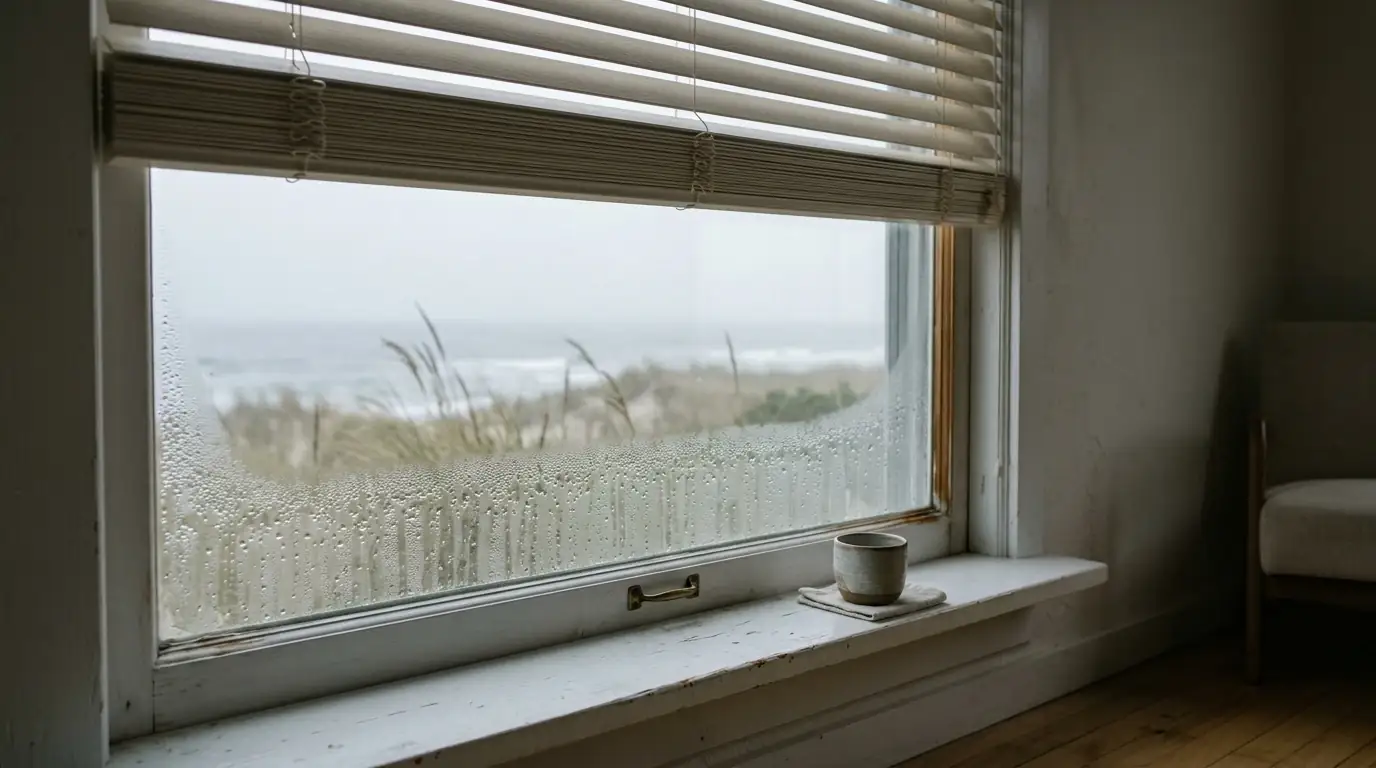
Leave the air conditioning running and set the thermostat in the high 70s. That is the short answer to what temperature to leave a vacant house in summer, and it holds for a Grand Strand beach house that sits closed for months. An empty house here does not need to be cold so much as it needs to stay dry, which is a different job than most vacant-house advice describes.
Quick answer
What to set it to before you leave
Set the thermostat to 78 degrees in the cooling season and leave the system on cool, never off. Set the fan to auto. Aim to hold indoor humidity between 30 and 50 percent, the range the EPA recommends. Before you lock up, have Comfort Masters check the system in North Myrtle Beach.
On this page
- 01What to set it to before you leave
- 02Why humidity, not heat, is the risk
- 03Summer vacancy versus winter vacancy
- 04Before you lock up
- 05When to stop and call 911
- 06Common questions
- 07Sources and references
Why humidity, not heat, is what damages an empty coastal house
Heat alone will not ruin a closed-up house. Moisture will. On the Grand Strand the outdoor air carries moisture all season, and a building that sits sealed and unconditioned comes into balance with it within days.
An air conditioner is also a dehumidifier, but only while it is running. Every cooling cycle pulls water out of the air and sends it down the condensate drain. Stop the cycles and you stop the drying.
What the EPA says about indoor humidity
The U.S. Environmental Protection Agency advises keeping indoor humidity below 60 percent, and ideally between 30 and 50 percent relative humidity, to control mold (EPA, A Brief Guide to Mold, Moisture and Your Home). The same guidance notes that damp materials dried within 24 to 48 hours usually do not grow mold.
Nobody is there to dry anything in an empty house. That is the whole problem. The thermostat setting is the only thing still working the moisture out, so treat it as a humidity control rather than a comfort setting. Our complete guide to coastal Carolina HVAC covers how the rest of the system handles that load.
Why setting it too high backfires
The Department of Energy notes you can save as much as 10 percent a year on heating and cooling by turning the thermostat back 7 to 10 degrees for 8 hours a day (U.S. Department of Energy, Programmable Thermostats). That figure is about a daily setback in an occupied home. It is not a plan for a house that sits closed for four months.
Push the setting far enough and the system stops cycling. A unit that rarely runs removes almost no moisture, and the house drifts toward the outdoor humidity. Coastal South Carolina sits in ASHRAE Climate Zone 3A, where summer design temperatures reach 93 to 96 degrees with sustained high humidity, so there is plenty of moisture waiting to move in.
No federal program publishes a required setpoint for an empty house. Pick the number from how the equipment behaves in this climate, not from a figure repeated on a national blog.
Summer vacancy versus winter vacancy on the Grand Strand
Houses here empty out on a schedule. Rental properties close out after the season in October, and seasonal residents head home through November and December. The two windows call for different settings.
Leaving in the cooling season
From April through October the system is doing real work, and the humidity load is at its heaviest. Leave it on cool at 78 degrees with the fan on auto. A fan left running can re-evaporate water sitting on the coil and push that moisture back into the rooms.
Hurricane season runs June 1 to November 30, per SC Emergency Management, and the most active stretch is August through October. A thermostat setting cannot survive a multi-day power outage, so somebody local needs a key. In Cherry Grove and the surrounding beach blocks that matters more than the number you chose, and our HVAC service in Cherry Grove covers those streets.
Leaving in the heating season
Do not switch the system off in winter either. Heat pumps are the common system on the Grand Strand, and a vacant house still needs enough heat to protect plumbing and finishes through a cold snap. Set it to 55 to 60 degrees on heat and leave it there.
Winters here are mild but not empty of cold fronts. A house held just above freezing is protected against the cold and still dry enough, because cold air holds far less moisture than the August air does.
Before you lock up: the pre-departure sequence
A vacant house quietly skips the upkeep a lived-in one gets. In cooling season the filter needs replacing every 30 to 60 days and the outdoor coil wants a monthly fresh-water rinse to clear salt before it sets. Nobody does either while you are gone.
Handle the cadence before you leave, or put someone on it while you are away. A service agreement is the usual answer for a second home, and our HVAC maintenance and service agreements are built around scheduled visits rather than emergency ones. If you are not sure how often a coastal system needs attention, we walk through it in how often to service HVAC in South Carolina.
Before you go
Five things to do before the house sits empty.
0 of 5 done
- Put in a fresh air filter so the system can move air and pull moisture for the whole stretch you are gone.Day you leave
- Clear the condensate drain. A line that backs up while nobody is home floods the pan and shuts the system down.Day you leave
- Rinse the outdoor coil with fresh water and keep two feet clear around the cabinet.Day you leave
- Leave a humidity sensor you can read remotely, so you find out about a problem in hours instead of in March.Before you go
- Give a neighbor or property manager a key, and book a pre-departure inspection so the system starts the stretch in known condition.Before you go
All five done. Your house is set up to ride out the season dry. For the pre-departure inspection, get in touch with our team before you head out.
Reset checklist
When to stop and call 911 instead
If you walk back into a closed-up house and smell gas, smell something burning, or see smoke, leave the house first. Then call 911 from outside. Do not flip a breaker, do not touch the thermostat, and do not wait to see whether it clears.
Call us after the fire department has cleared the house, not before.
Signs the system needs a technician before you go
Some things should be fixed on the way out, not discovered on the way back in. Call for a diagnosis if the house feels clammy at the right temperature, if the system runs constantly without satisfying the thermostat, if you find standing water near the air handler, or if there is a musty smell in the return air.
Weak cooling has a list of common causes, and we cover them in why an air conditioner stops cooling. Any of these means the system gets looked at before the house sits empty. Our HVAC repair and maintenance in North Myrtle Beach starts with a diagnosis in writing, and we recommend a repair before a replacement.
Common questions
Before you lock up, answered.
What temperature should I leave my beach house at when it is empty?
Set it to 78 degrees on cool during the cooling season, and 55 to 60 degrees on heat in winter. Leave the system running in both cases, with the fan on auto. The goal is holding humidity down, not keeping the house cold.
Should I turn the AC completely off while the house sits empty?
No. An air conditioner removes moisture only while it runs, so switching it off stops the drying entirely. Within days a closed-up house comes into balance with the outdoor humidity. Leave it on cool at a moderate setting and let it cycle.
What humidity level keeps mold out of a closed-up coastal house?
The EPA advises keeping indoor humidity below 60 percent, and ideally between 30 and 50 percent relative humidity. It also notes that damp materials dried within 24 to 48 hours usually do not grow mold. Nobody is there to dry anything in an empty house.
What should I set the thermostat to for an empty house in winter?
Set it to 55 to 60 degrees on heat and leave it there. Grand Strand winters are mild, but cold fronts still arrive, and a vacant house needs enough heat to protect plumbing and finishes. Do not switch a heat pump off for the season.
Does a smart thermostat vacation mode handle this on its own?
It handles the schedule, not the condition of the equipment. Vacation mode holds one setting until you change it, which is useful, but it cannot rinse a coil, clear a condensate drain, or tell you the system is struggling. Set the mode and still book an inspection.
What happens to my settings if the power goes out while I am away?
Most thermostats return to their prior schedule when power comes back, but the system is off for the whole outage and the house gains humidity the entire time. Hurricane season runs June 1 to November 30. Give someone local a key.
References
Sources and references.
- U.S. Environmental Protection Agency A Brief Guide to Mold, Moisture and Your Home. Keep indoor humidity below 60 percent, ideally between 30 and 50 percent relative humidity. Damp materials dried within 24 to 48 hours usually do not grow mold.
- U.S. Department of Energy Programmable Thermostats. Turning the thermostat back 7 to 10 degrees for 8 hours a day can save as much as 10 percent a year on heating and cooling.
- South Carolina Emergency Management Division Hurricane Preparedness Month. Hurricane season begins June 1 and lasts through November 30.
Before you head out
Have it checked before the house sits empty.
Comfort Masters Heating & Cooling works on coastal systems across North Myrtle Beach and the Grand Strand from its shop at 3502 State Hwy 50 in Little River. A service call is $55 in Little River and Calabash and $95 in the other service areas, and it includes a full diagnostic with written findings before any repair is quoted. Maintenance agreements run $115 a year for one visit and $175 a year for two.
Call (843) 443-7186 Schedule a pre-departure inspection
Service area
HVAC across the Grand Strand.
Comfort Masters Heating & Cooling provides coastal HVAC service across North Myrtle Beach and the Grand Strand from 3502 State Hwy 50 in Little River, SC 29566.
Comfort Masters Heating & Cooling 3502 State Hwy 50, Little River, SC 29566 (843) 443-7186 Get directions
Areas we serve
- North Myrtle Beach
- Little River
- Calabash
- Cherry Grove
- Longs
- Loris
- Myrtle Beach
- Sunset Beach
- Ocean Isle Beach
Professionally reviewed by

Alex Todd
- ACCA Manual J
- ACCA Manual S
- ACCA Manual D
- EPA 608
- SC HVAC #38846
- NC HVAC #36196
Owner and lead HVAC technician at Comfort Masters Heating & Cooling, working on coastal systems across the Grand Strand since 2019 and using ACCA Manual J, S and D standards on every design.
Reviewed: September 2026