
Whole house dehumidifier cost for coastal Carolina homes (2026)
A whole house dehumidifier usually costs between 1,300 and 2,800 dollars installed on the Grand Strand, based on 2026 cost guides. Here is what changes that price, whether it is worth it for a coastal Carolina home, and how Comfort
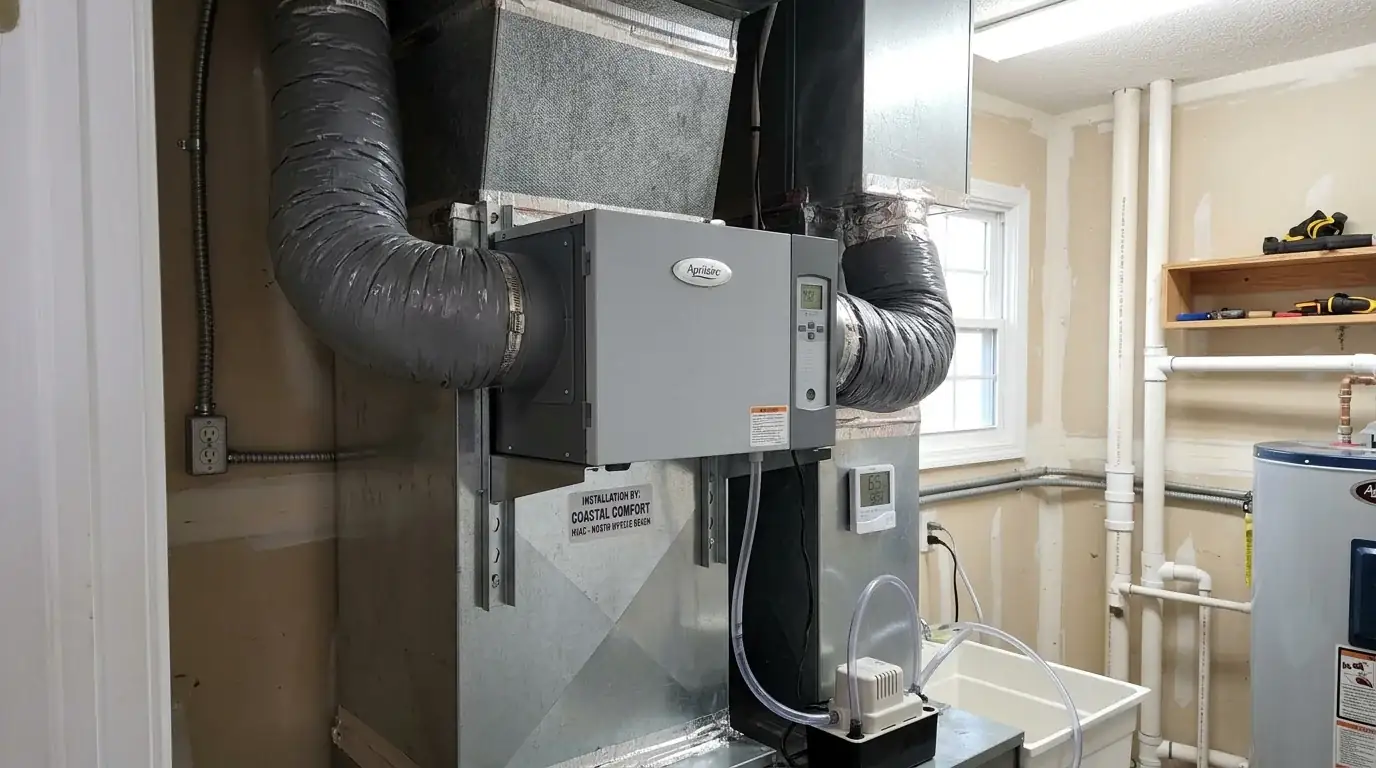
In North Myrtle Beach, a whole house dehumidifier usually costs between $1,300 and $2,800 installed, based on 2026 cost guides, and the honest first step is a $55 diagnosis visit that tells you whether you need one at all. A coastal home works against humidity from April to October, so the question is fair. Here is what whole house dehumidification really costs on the Grand Strand, and how to tell if it is worth it for your home.
One thing up front. We cannot price your exact system from a blog post, and we will not push a dehumidifier on a home that needs a duct repair or a right-sized air conditioner instead. The ranges below come from national cost guides. The real number depends on your home, your ductwork, and how your current system handles moisture. That is what the diagnosis is for.
Quick answer
What does a whole house dehumidifier cost in coastal SC?
In North Myrtle Beach, a whole house dehumidifier usually costs $1,300 to $2,800 installed, and up to about $3,500 for a complex ducted job, based on 2026 national cost guides. Comfort Masters starts with a $55 diagnosis visit in Little River and Calabash, $95 elsewhere, and puts every recommendation in writing.
On this page
- 01What one costs on the coast
- 02Cost by dehumidifier type
- 03What moves the price
- 04Is it worth it here
- 05How we size and install it
- 06Common questions
Key things to know about whole house dehumidifier cost
If you read nothing else, these five points cover what drives the price and the decision on the Grand Strand.
- Installed cost runs $1,300 to $2,800. That is what most homeowners pay, per the 2026 Angi and HomeGuide cost guides, with a complex ducted job reaching about $3,500.
- Size is capacity, not square footage. A whole-house unit is matched to your home’s moisture load and runs from about 60 to 150 pints per day.
- The coast raises the load. Grand Strand summers sit in a hot, humid climate zone, so a coastal home pulls in more moisture than an inland one.
- The target is 30 to 50 percent humidity. That is the range the EPA recommends indoors to control mold and dust mites.
- A dehumidifier is not always the fix. An oversized air conditioner or leaky ducts can cause the damp feeling, which a diagnosis catches before you buy anything.
What a whole house dehumidifier costs in coastal SC
A whole house dehumidifier costs $1,300 to $2,800 installed for most homeowners, and averages around $1,500, according to the 2026 Angi and HomeGuide cost guides. Coastal homes tend to land toward the upper end, because a humid climate calls for more capacity and, often, a tie-in to existing ductwork. A complex ducted install with a pump or added drainage can reach about $3,500.
Those figures cover the unit and professional installation, which the same guides put at $500 to $1,000 on its own. Running the unit adds roughly $10 to $30 a month to your power bill. None of that is a Comfort Masters quote. It is the national market, and your real number comes from measuring your home.
What it costs
Whole house dehumidification, by the numbers.
What most homeowners pay
Whole-house unit
Installed, typical
$1,300 to $2,800
Unit plus professional installation, per 2026 cost guides.
Complex job
Ducted or with a pump
Up to $3,500
Duct integration, a condensate pump, or added drainage.
What moves the price within those ranges
System capacity. Set by your home’s moisture load, not its square footage. Whole-house units run about 60 to 150 pints per day.
Ducted or standalone. Tying the unit into your HVAC ductwork costs more than a standalone unit set in a crawl space.
Drainage and electrical. A condensate drain route, a pump, and a dedicated circuit can each add to the total.
Coastal humidity load. A Grand Strand home in a hot, humid zone needs more capacity than an inland one.
Ranges per the Angi and HomeGuide 2026 cost guides. Comfort Masters quotes every install in writing after measuring the home.
Cost by dehumidifier type
Not every dehumidifier is the same machine. Three types come up on the coast, and they price differently.
Whole-house ducted dehumidifier
This unit ties into your HVAC return and treats the whole home through the ductwork. It carries the fuller installed cost, typically toward the $2,000 to $3,500 end once the tie-in and drainage are done, and it is the option most people mean by whole house dehumidification.
Standalone crawl-space dehumidifier
Beach and slab homes often have a damp crawl space rather than a basement. A standalone unit set in that space runs on the lower side of the installed range and targets the moisture where much of it starts.
Portable dehumidifier
A portable unit is not the same thing. It costs far less up front, but it drains into a tank you empty by hand and treats one room, not a whole home. For a persistent coastal humidity problem, it is a stopgap, not a fix.
Equipment cost versus installed cost
The unit is only part of the bill. The 2026 cost guides put professional installation at $500 to $1,000 on top of the equipment, and that labor is where a coastal install earns its keep. Routing the condensate line so it drains cleanly, sizing the unit to the home, and tying it into the ductwork correctly are the difference between a unit that quietly holds humidity in the range the EPA recommends and one that trips a float switch every August.
What moves the price on the coast
Three things drive most of the gap between a low quote and a high one: the capacity your home needs, whether the unit ties into ductwork or stands alone, and the drainage and electrical the install requires. The coastal climate sits underneath all three, because it sets how hard the unit has to work.
50percent
Aim to keep indoor humidity between 30 and 50 percent.
That is the range the EPA recommends to limit mold and dust mites. A coastal home that stays above it feels clammy even when the thermostat reads right.
Recommended indoor humidity range per the U.S. EPA.
Why the coast stays damp
How coastal humidity builds up indoors.
Humid ocean air
Grand Strand air carries heavy moisture through the long cooling season.
It seeps inside
Moisture rides in through doors, the crawl space, and every time the AC cycles off.
AC alone falls short
An air conditioner removes some moisture, but not enough on the most humid days.
Damp air, mold risk
Humidity climbs past 60 percent, where mold and dust mites take hold.
The fix: a right-sized dehumidifier holds the whole home in the 30 to 50 percent range the EPA recommends, working with the air conditioner rather than replacing it.
System capacity
Capacity is the biggest lever. A unit that is too small never catches up in August, and one that is too large short-cycles and wastes money. Sizing comes from your home’s moisture load, the same way we size an air conditioner with a Manual J load calculation from the Air Conditioning Contractors of America. Our coastal Carolina HVAC guide goes deeper on why sizing matters here.
Ducted versus standalone installation
A whole-house dehumidifier that ties into your ductwork costs more to install than a standalone unit dropped into a crawl space, because it means cutting into the return, sealing the connection, and balancing airflow. A standalone unit is simpler, and for a damp crawl space under a beach home it is often the better call. You can see the equipment options on our indoor air quality accessories page.
Ductwork, drainage, and electrical
The unit needs somewhere to send the water it pulls out. A gravity drain is cheapest, a condensate pump adds cost, and a long run to a floor drain adds more. Most units also want a dedicated circuit. On the coast, we check that your existing ducts are sealed too, because leaky ducts pull humid air in from the crawl space and undo the work.
Is a whole house dehumidifier worth it in coastal SC?
For a lot of Grand Strand homes, yes, but not every home needs one, and we will tell you when it does not. Here is how to think it through.
When it pays off
If your house feels clammy at 72 degrees, smells musty after a rain, or grows mildew on closet walls, a whole-house dehumidifier usually earns its cost. It protects the home itself, not just your comfort, and it holds humidity in the 30 to 50 percent range the EPA recommends, which matters for anyone sensitive to mold or dust. A vacation rental that sits closed up between guests is a strong candidate, because a damp, empty house is where mildew starts. Our post on fresh air in your home covers the air-quality side.
When a portable or a tune-up is enough first
Sometimes the damp feeling is not a dehumidifier problem at all. An oversized air conditioner cools the air fast and shuts off before it removes moisture, and leaky ducts pull humid crawl-space air into the house. Both feel like a humidity problem and are fixed differently. A single damp room might only need a portable unit. That is why we diagnose before we recommend, and it is a real service call, not a guess. If you are chasing a musty smell, a professional tune-up and diagnosis is the right first step.
The break-even math
A whole-house dehumidifier runs about $10 to $30 a month, per 2026 cost guides, against a $1,300 to $2,800 install. Weigh that against what humidity costs you: warped floors, mildew, a musty smell that never leaves, and an air conditioner working overtime. For a coastal home that fights moisture six months a year, the math usually favors the dehumidifier. For a tight, well-sealed home that only feels damp on the worst days, it may not. A maintenance plan that keeps your system dehumidifying well can close part of the gap.
How Comfort Masters sizes and installs it
Our approach is the same one we bring to every system: measure first, recommend second, and put it in writing. Our technicians do not work on commission, so the goal is the right fix for your home, not the biggest invoice.
We measure the moisture load
We start with a diagnosis of how your home gains and holds moisture, using the ACCA Manual J and Manual D methods that also govern how we size air conditioners and design ducts. That tells us the capacity you actually need and whether a ducted or standalone unit fits your home. You get the findings in writing. That is what we mean by engineered, not estimated.
We install it and stand behind it
We set the unit, route the drain, tie it into the ductwork where that is the plan, and pull the permits Horry County and Brunswick County require. Every new installation carries a three-year labor warranty. If a dehumidifier turns out to be part of a larger comfort fix, our new system installation page walks through the rest.
Paying for it
A dehumidifier does not have to be paid all at once. Comfort Masters offers financing through Synchrony, and you can review the current terms on that page. We do not publish rates here, because the terms come from the lender. If anyone in the home has trouble breathing in damp or moldy air, treat that as a health issue and call a doctor, then call us to fix the source.
Licensed in SC & NC SC #38846 · NC #36196
Written quote first No work without sign-off
3-year labor warranty On every new install
Repair-first diagnosis Technicians are not on commission
Common questions
Whole house dehumidifier cost, answered.
How much does a whole house dehumidifier cost installed?
A whole house dehumidifier costs 1,300 to 2,800 dollars installed for most homeowners, and averages around 1,500 dollars, according to the 2026 Angi and HomeGuide cost guides. A complex ducted job with a pump or added drainage can reach about 3,500 dollars. Comfort Masters quotes your home in writing after measuring it.
Is a whole house dehumidifier worth it in coastal SC?
For many Grand Strand homes, yes. If the house feels clammy at 72 degrees, smells musty, or grows mildew, a whole-house unit usually earns its cost by protecting the home and holding humidity in the 30 to 50 percent range the EPA recommends. Some homes only need a duct fix, which a diagnosis catches first.
What are the pros and cons of a whole house dehumidifier?
The main benefit is steady, whole-home humidity control that an air conditioner alone cannot manage on the most humid coastal days. It also protects floors, closets, and air quality. The trade-offs are the 1,300 to 2,800 dollar install and about 10 to 30 dollars a month to run it, per the 2026 cost guides.
How does a whole house dehumidifier work?
A whole house dehumidifier pulls air across a cold coil that condenses moisture out, then sends drier air back into the home. A ducted unit ties into your HVAC system and treats every room, while a standalone unit conditions one space such as a crawl space. The water drains away continuously, with no tank to empty.
What size whole house dehumidifier does a coastal home need?
Capacity is set by your home’s moisture load, not its square footage, and whole-house units run from about 60 to 150 pints per day. A home under 2,600 square feet is often fine with a 100-pint unit, per the 2026 cost guides. A coastal home in a humid climate usually needs more capacity than an inland one.
Whole house dehumidifier versus a portable one: what is the difference?
A portable dehumidifier treats one room and drains into a tank you empty by hand. A whole house unit treats the entire home, drains continuously, and runs quietly in the background. For a single damp room a portable is fine. For a home that fights humidity all summer, whole-house dehumidification is the lasting fix.
Where is a whole house dehumidifier installed?
A ducted whole-house dehumidifier is usually installed near the air handler and tied into the return ductwork, so it treats air throughout the home. In beach and slab homes without a basement, a standalone unit often goes in the crawl space, where much of the coastal moisture comes from. The best spot depends on your home’s layout.
Does a whole house dehumidifier lower cooling bills?
It can help. Drier air feels cooler, so you can set the thermostat a degree or two higher and stay comfortable, which trims runtime. The dehumidifier uses its own energy, about 10 to 30 dollars a month per the 2026 cost guides, so the net savings vary. The bigger payoff is comfort and protecting the home from moisture.
Does a whole house dehumidifier help with mold and musty smells?
Yes, when the problem is humidity. Mold and dust mites take hold above 60 percent relative humidity, according to the EPA, so holding a home in the 30 to 50 percent range removes the conditions they need. If a musty smell comes from a leak or standing water instead, that source has to be fixed first.
What humidity level should a coastal home hold?
The EPA recommends keeping indoor relative humidity below 60 percent, and ideally between 30 and 50 percent, to control mold and dust mites. On the Grand Strand, hitting that range through a humid summer often takes more than an air conditioner, which is where a right-sized dehumidifier helps. A hygrometer lets you check where your home sits.
Who installs whole house dehumidifiers near North Myrtle Beach?
Comfort Masters Heating and Cooling installs whole-house dehumidifiers across North Myrtle Beach and the Grand Strand from its shop in Little River. We size the unit to your home’s moisture load, tie it into your system, and back the work with a three-year labor warranty. A diagnosis visit is 55 dollars in Little River and Calabash, 95 dollars elsewhere.
How long does a whole house dehumidifier last on the coast?
A whole house dehumidifier lasts longer when it is sized correctly and maintained. Coastal salt air and heavy summer use are hard on any equipment, so changing the filter, keeping the coil clean, and having it checked during a yearly HVAC tune-up all help. Sizing it right at the start matters most for how long it holds up.
Does a whole house dehumidifier need maintenance?
Yes. A whole house dehumidifier has a filter and a coil that need cleaning, and a drain line that has to stay clear so it does not back up. On the coast, that upkeep matters more because of salt and heavy runtime. It folds easily into a yearly HVAC tune-up, and our maintenance plans cover that visit.
What does a Comfort Masters diagnosis visit cost?
A diagnosis visit is 55 dollars in Little River and Calabash, and 95 dollars in the other service areas. It covers a full check of how your home handles moisture, with written findings, before anyone recommends a dehumidifier or anything else. The fee is for the diagnosis. Any install is quoted separately after we measure.
Sources and references
- U.S. Environmental Protection Agency, Mold Course Chapter 2: Why and Where Mold Grows (indoor humidity 30 to 50 percent). epa.gov
- Angi, Whole House Dehumidifier Cost (2026). angi.com
- HomeGuide, How Much Does a Whole-House Dehumidifier Cost? (2026). homeguide.com
- Air Conditioning Contractors of America, Manual J Residential Load Calculation. acca.org
Ready when you are
Find out if your coastal home needs one.
Comfort Masters Heating & Cooling works on coastal systems across North Myrtle Beach and the Grand Strand from its shop at 3502 State Hwy 50 in Little River. A diagnosis visit is 55 dollars in Little River and Calabash and 95 dollars in the other service areas, with written findings before anyone recommends a dehumidifier. We measure your home, then put the plan in writing.
Call (843) 443-7186 Book Online
Service area
HVAC across the Grand Strand.
Comfort Masters Heating & Cooling provides coastal HVAC and indoor air quality service across North Myrtle Beach and the Grand Strand from 3502 State Hwy 50 in Little River, SC 29566.
Comfort Masters Heating & Cooling 3502 State Hwy 50, Little River, SC 29566 (843) 443-7186 Get directions
Areas we serve
- North Myrtle Beach
- Little River
- Calabash
- Cherry Grove
- Longs
- Loris
- Myrtle Beach
- Sunset Beach
- Ocean Isle Beach