
How often should you change your HVAC air filter in SC?
Most one-inch HVAC air filters in coastal South Carolina need changing every 30 to 60 days, sooner than the usual 90-day rule, because salt air, humidity, and heavy summer runtime load them faster. This guide covers what sets your real schedule, how to check and change a filter, common myths about MERV, and when a clogged filter is a sign to call a professional.
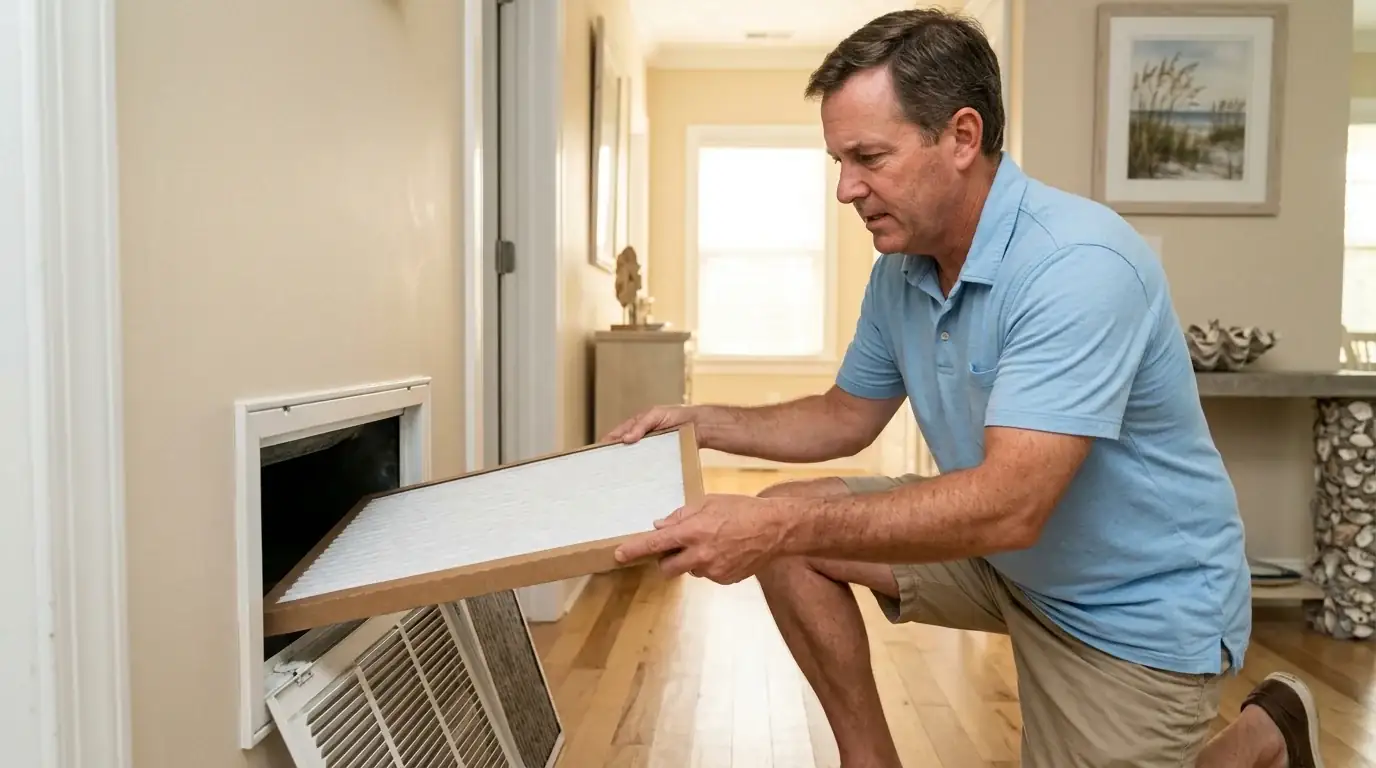
Most one-inch HVAC air filters in coastal South Carolina need changing every 30 to 60 days, sooner than the common 90-day rule you see online. Salt air, humidity, and near constant summer runtime load a filter faster here than inland. This guide covers how often to change your air filter, what changes the timing, and when a clogged filter is a sign of a bigger problem. For the wider picture, see our coastal Carolina HVAC guide.
Quick answer
How often should you change your HVAC air filter?
Change a standard one-inch filter every 30 to 60 days on the coast, and check it once a month. ENERGY STAR recommends replacing any filter at least every three months, and coastal salt, humidity, and heavy runtime push most Grand Strand homes to the shorter end. Thicker four-inch and five-inch media filters last longer.
On this page
- 01Key things to know
- 02Why cadence matters on the coast
- 03What determines how often
- 04How to check and change it
- 05Common myths about filters
- 06When to call a professional
- 07Common questions
Key things to know
What to remember about filter changes.
0 of 5 done 0%
- Change a one-inch filter on the coastal cadence so airflow and dehumidification stay strong.Every 30 to 60 days
- Check the filter by eye by holding it up to a light to see if the light still passes through.Monthly
- Match the exact size printed on the edge of the old filter frame, and mind the airflow arrow.Every purchase
- Choose a MERV your system can handle, usually in the 8 to 13 range for a home.Per system
- Call a professional if airflow or cooling stays weak after you install a clean filter.As needed
That is the whole routine. When it is time for the professional side of the job, book HVAC maintenance and repairs ahead of the season.
Reset checklist
Why your filter cadence matters more on the coast
The air filter is the cheapest part of your system and the one that protects everything downstream of it. On the Grand Strand it also gets dirty faster, so the schedule that works inland runs too long here.
What a dirty filter does to your system
A clogged filter chokes the return airflow the blower depends on. When air cannot move freely, the system works harder, the evaporator coil can drop below freezing, and the blower motor runs under strain. According to the U.S. Department of Energy, replacing a dirty filter with a clean one can lower an air conditioner’s energy use by 5 to 15 percent.
That makes the filter the single easiest way to protect efficiency and equipment life. A fresh filter is a two-minute job. A frozen coil or a burned-out blower is a service call.
Why coastal Carolina homes clog filters faster
Coastal South Carolina sits in a hot and humid climate zone, and the same salt and moisture that wear on outdoor equipment also ride into the return air. Pollen, fine dust, and pet dander add to the load, and a long cooling season keeps the system pulling air through the filter almost nonstop.
Humidity control is part of the picture too. A filter that stays clean lets the system run the steady cycles that pull moisture out of the house. When a home still feels damp at the right temperature, a whole-house dehumidifier can carry the load a filter alone cannot.
30days
In peak season, a coastal one-inch filter can need changing as often as every 30 days.
Plan on every 30 to 60 days through the summer, when salt, humidity, and heavy runtime load a filter fastest. ENERGY STAR recommends replacing any filter at least every three months as the outer limit.
Coastal cadence per Comfort Masters field guidance; three-month maximum per ENERGY STAR.
Why the coast loads a filter faster
What fills a coastal filter before its time.
Salt and sea air
Airborne salt and moisture drift inland and ride into the return with every cycle.
Pollen and coastal dust
Spring and summer pollen plus fine dust add to the load the filter has to catch.
Near constant runtime
Long, humid summers keep the system pulling air through the filter almost nonstop.
Fuller, faster
More particles through more air means the filter clogs weeks before an inland one.
The fix is a habit, not a product. Check the filter every month, and change it every 30 to 60 days through cooling season so airflow and dehumidification stay strong.
What determines how often you should change it
Three things set your real schedule: the filter you use, who lives in the house, and how hard the system runs. Start at the coastal window of 30 to 60 days, then adjust up or down based on the factors below.
Filter type and MERV rating
MERV, or minimum efficiency reporting value, is defined by ASHRAE Standard 52.2 and rates a filter from 1 to 16 on how well it captures particles. Most homes are matched to a filter in the 8 to 13 range, and thickness matters as much as rating, because a thicker filter holds more before it restricts airflow.
One-inch fiberglass and pleated filters
These are the common sliding filters at a return grille or the air handler. A basic fiberglass filter protects the equipment but catches less, while a one-inch pleated filter captures more and needs changing on the shorter coastal cadence.
Four- and five-inch media filters
These thick, cabinet-mounted filters have far more surface area, so they load more slowly and can last several months even here. Follow the manufacturer interval, and still check them by eye during heavy runtime.
Your household: pets, allergies, and occupancy
Pets, allergies, and more people in the home all raise the particle load and shorten the interval. According to the U.S. Environmental Protection Agency, a good filter is a core part of controlling indoor particles, so a home with two dogs will run through filters faster than a couple with none.
Season and system runtime
Runtime is the biggest lever on the coast. From June through August a Grand Strand system runs nearly continuously, so filters need the most frequent changes. In the mild shoulder months the interval stretches, and a vacation rental that runs hard all summer needs its filter checked more often than a lightly used second home.
How to check and change your filter
You do not need tools or training for this. A monthly look and a two-minute swap cover it.
How to tell when a filter is due
Pull the filter and hold it up to a light. If light no longer passes through the pleats, it is due. A visible grey mat of dust across the surface, weaker airflow at the vents, or a longer runtime to hit the same temperature are all signs the filter is loaded.
Changing a one-inch filter, step by step
The swap follows the same five steps every time.
- Turn the system off at the thermostat so it does not pull air or debris while the slot is open.
- Find the filter at the return grille or the air handler cabinet, and slide the old one out.
- Read the size printed on the frame edge, such as 16x25x1, and note the airflow arrow.
- Slide the new filter in with its arrow pointing toward the blower and ductwork, the same way the old one faced.
- Turn the system back on, and write the date on the new filter frame so the next change is easy to time.
Picking the right replacement
Match the exact size printed on the old frame, since a loose filter lets air slip around it unfiltered. Then choose a MERV your system is rated to handle. A higher number captures more, but only if the blower can move air through it, which is why the system, not the shelf label, sets the ceiling.
Common myths about air filters
A few widely repeated ideas cost homeowners money or comfort. Here is what holds up.
Myth: a higher MERV filter is always better
A higher MERV captures finer particles, but a filter that is too restrictive for your blower starves the system of airflow and can freeze the coil. The right MERV is the highest one your system is rated to move air through, not the highest one on the shelf.
Myth: changing it once a year is enough
An annual change is far too long for coastal cooling. ENERGY STAR sets three months as the outer limit for most filters, and salt, humidity, and summer runtime push the Grand Strand to every 30 to 60 days for one-inch filters.
Myth: a clean filter fixes weak cooling
A fresh filter often restores airflow, but not always. If cooling stays weak after a clean filter, the cause may be low refrigerant, a failing blower, or a frozen coil. Our guide on why your AC is not cooling walks through what to check next.
When to call a professional
Changing the filter is your job. Diagnosing what a fresh filter does not fix is ours.
Signs it is more than a dirty filter
Call for service when the system short cycles, when ice forms on the refrigerant line or coil, or when airflow stays weak after you install a clean filter. A burning smell or the smell of gas is a safety issue, not a maintenance one. Leave the home and call 911 and your gas utility first, then reach an HVAC professional.
What a maintenance visit covers
A professional tune-up goes past the filter to clean the coil, clear the condensate drain, and check airflow and refrigerant. For how that schedule fits the rest of your system, see how often to service your HVAC, and an HVAC maintenance plan keeps those visits on a set cadence.
Common questions
Changing your air filter, answered.
How often should you change a one-inch HVAC air filter?
On the coast, change a one-inch filter every 30 to 60 days, and check it monthly. ENERGY STAR recommends replacing any filter at least every three months. Salt air, humidity, and heavy summer runtime load coastal filters faster, so the Grand Strand runs on the shorter end of that range.
Does a dirty air filter make your AC less efficient?
Yes. A clogged filter restricts airflow and makes the system work harder. The U.S. Department of Energy reports that replacing a dirty filter with a clean one can lower an air conditioner’s energy use by 5 to 15 percent, so a fresh filter protects both efficiency and equipment life.
What MERV rating is best for a home HVAC system?
Most homes use a filter rated MERV 8 to 13, which balances particle capture against airflow. MERV is defined by ASHRAE Standard 52.2 on a scale of 1 to 16. The best choice is the highest rating your specific blower is designed to move air through.
Why do air filters get dirty faster near the beach?
Coastal air carries salt, moisture, pollen, and fine dust that ride into the return with every cycle. A long, humid cooling season also keeps the system running almost nonstop. Together these load a Grand Strand filter weeks faster than an inland one, which is why the coastal cadence is shorter.
What happens if you do not change your air filter for a long time?
Airflow drops as the filter clogs, which forces the blower to strain and can freeze the evaporator coil. The system runs longer to reach the same temperature and can fail early. If cooling stays weak after a fresh filter, have an HVAC professional check the system.
How do I find my air filter size?
The size is printed on the cardboard edge of the old filter, shown as three numbers such as 16x25x1 for length, width, and thickness. Match that size exactly, since a loose filter lets air slip around it unfiltered. Note the airflow arrow before you remove it.
Sources and references
- U.S. Department of Energy, Maintaining Your Air Conditioner (filter replacement can lower energy use by 5 to 15 percent). energy.gov
- ENERGY STAR, HVAC maintenance guidance (check monthly, replace at least every three months). energystar.gov
- ASHRAE Standard 52.2, Method of Testing General Ventilation Air-Cleaning Devices (the MERV 1 to 16 scale). ashrae.org
- U.S. Environmental Protection Agency, Guide to Air Cleaners in the Home. epa.gov
Ready when you are
A fresh filter did not fix it? Let us take a look.
Comfort Masters Heating & Cooling works on coastal systems across North Myrtle Beach and the Grand Strand from its shop at 3502 State Hwy 50 in Little River. A service call is $55 in Little River and Calabash and $95 in the other service areas, and it includes a full diagnostic with written findings before any repair is quoted.
Call (843) 443-7186 Book Online
Service area
HVAC across the Grand Strand.
Comfort Masters Heating & Cooling provides coastal HVAC service across North Myrtle Beach and the Grand Strand from 3502 State Hwy 50 in Little River, SC 29566.
Comfort Masters Heating & Cooling 3502 State Hwy 50, Little River, SC 29566 (843) 443-7186 Get directions
Areas we serve
- North Myrtle Beach
- Little River
- Calabash
- Cherry Grove
- Longs
- Loris
- Myrtle Beach
- Sunset Beach
- Ocean Isle Beach